
Project Business leadership requires creativity and finding value in what we already have in-house to reduce dependencies and transactional costs associated with the make or buy calculus.
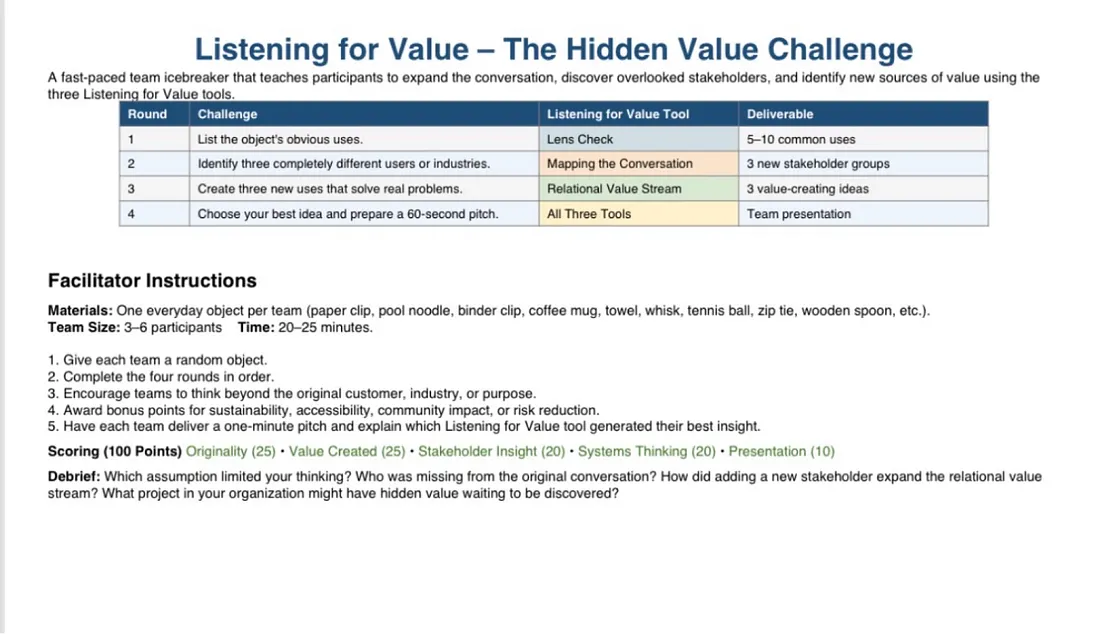
In this one hour workshop, you’ll practice creative repurposing and imagination spurred by the history of some accidental discoveries like the Slinky.
In this context, the “product” is the working relationship between partners in project business. Where is the value hidden in front of our eyes?
Background
he Slinky.
It was created as a spring that could help stabilize sensitive naval instruments. During development, Richard James accidentally dropped one of the springs. It didn’t simply fall. It walked.
An engineer saw an interesting mechanical property.
His wife, Betty, saw something entirely different. She saw a toy. She recognized a new customer, a new purpose, and a new source of value. The spring didn’t change. The conversation around it did.
That story captures one of the central ideas behind Listening for Value.
We often assume innovation begins with inventing something new. Just as often, it begins by listening differently.
New value appears when we invite new perspectives, question our assumptions, and connect people who were never part of the original conversation.
Today you’ll practice doing exactly that.
Each team will receive an ordinary object.
Your job isn’t to improve it.
Your job is to discover value that its original designer may never have imagined.
As you work, use the three Listening for Value tools.
Mapping the Conversation asks, “Who isn’t at the table?”
Every new stakeholder brings different experiences, needs, and possibilities.
The Relational Value Stream asks, “How does value move through people and relationships?”
An object can create entirely different value when it reaches a different user, industry, or community.
The Lens Check asks, “What assumptions are limiting our thinking?” Sometimes the only thing preventing innovation is believing an object has just one purpose.
There are no wrong answers in this exercise.
Some of the best ideas in history began as accidents, unexpected observations, or solutions to entirely different problems.
Post-it Notes, Bubble Wrap, Velcro, microwave ovens, and the Slinky all became successful because someone looked beyond the original intention and recognized hidden value.
Your challenge is to do the same.
By the end of this activity, you won’t just have generated creative ideas.
You’ll have practiced expanding conversations, strengthening relational value streams, and discovering opportunities that become visible only when we learn to listen for value.
- T. Casey LaFrance
- Dr. Harri Emari