

AEP Accreditation
(Accredited Education Partner)
On this page: Why should you join? *** Costs and process *** AEPs and business case

Why Should an Education Provider Join the AEP Program?
The Project Business Foundation is launching its new AEP program to help education providers swiftly stake a claim in a rapidly developing market: The management of Project Business.
What We Know about this Market:
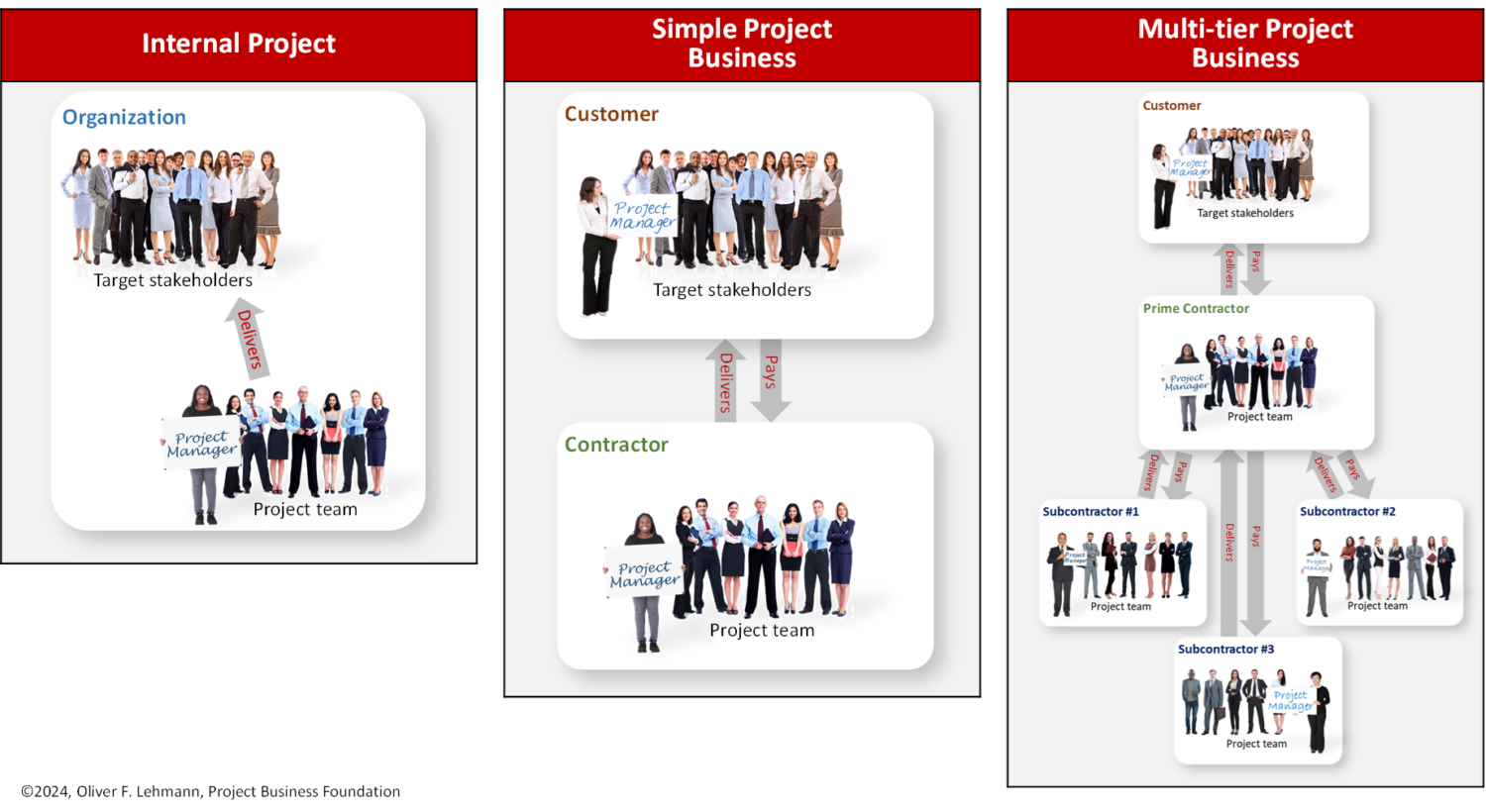
Modern projects are rarely done inside just one organization. Instead, they are performed by two or more organizations (Details):
- Customers implementing strategic procurement.
- Contractors generating critical income from projects.
This requires domain-specific education:
- Project managers in cross-corporate projects describe themselves as under-educated (Details ↗).
- Project managers are poorly prepared and supported in managing cross-corporate projects on both sides, customers and contractors (Details ↗).
- Conflicts in cross-corporate projects mostly arise from conflicting business interests of the parties involved (Details ↗).
- In large cross-corporate projects, trouble mostly originates not inside the organizations involved but at the interfaces between them (Details ↗).
Project managers must be better prepared for the management of cross-corporate projects to cope with the challenges their employers face.
This is where the Project Business Foundation helps AEPs unlock new business opportunities.
For Academia
🎓 Theory and Practice for Experts 🎓
Universities and colleges are under pressure to make curricula relevant to current business realities.
Lecture-only courses on internal project management aren’t enough when graduates enter fields where cross-corporate relationships, contracting, and commercial risk drive daily decisions. The AEP program offers a concrete bridge from academic theory to applied professional readiness:
- Structured, professional curriculum integration. AEP gives academic programs access to course content and certification pathways tailored to the commercial realities of project business — adding rigor and relevancy to your teaching.
- Preparation for a recognized credential. Students who complete PBP preparation under an accredited partner can sit the certification exam as part of their coursework, giving them an industry-recognized credential upon graduation.
- Employer appeal. Graduates who can demonstrate both conceptual understanding and certification-aligned competency are more attractive to companies dealing with outsourced projects, vendor ecosystems, and global delivery networks. That’s not a niche anymore — it’s increasingly standard.
- Collaboration opportunities. Partnering with the Foundation opens doors for guest lectures, joint research, and case study development that keep your teaching anchored in cutting-edge practice.
In academia, credibility and real-world linkage matter. AEP status lets you weave professional competency development into academic programs without compromising scholarly standards — it’s a pragmatic way to prepare students for the complexity of modern project business.
For L&D Departments
🎯 Commercial Competence Where It Matters 🎯
Many internal L&D (Learning & Development) teams offer strong project management training. Yet when projects cross corporate boundaries — customers, contractors, subcontractors, consortium partners — the risks change fundamentally. Commercial exposure, contractual obligations, cashflow dependencies, and legal escalation are no longer peripheral topics. They define success or failure for their employers.
The AEP framework enables L&D departments to close this gap systematically.
- Targeted competence for customer projects. Equip project managers, contract managers, bid teams, and PMO staff with structured knowledge of cross-corporate risk, change management under contract, claims, and commercial exposure.
- Alignment with strategic procurement. Organizations that apply strategic sourcing and category management in projects benefit when procurement professionals and project managers share a common understanding of contract structures, supplier risk, bid evaluation, and lifecycle commercial impact.
- Standardized capability across regions. The PBP framework provides a consistent language and structure for global teams working in different jurisdictions but facing similar contractual realities.
- Professional certification pathway. Employees can prepare for and earn a recognized credential that signals commercial literacy — not just scheduling competence.
- Scalable internal rollout. Programs can be delivered in partnership with accredited trainers or built into your internal academy over time, creating sustainable in-house capability.
- Risk reduction through education. Well-trained teams escalate earlier, document better, negotiate more realistically, and understand when a technical issue becomes a commercial threat.
In short, this is not another generic project course. It is a structured way to strengthen commercial resilience in project environments where misunderstandings, weak contract handling, or unmanaged change requests directly translate into financial damage.
If your organization runs customer projects, supplier projects, or complex delivery networks, the question is not whether this competence is useful — but whether you want it built deliberately or learned the hard way.
For Training Providers
🗣️ Grow Your Portfolio and Market Reach 🗣️
Commercial training organizations face a brutal truth: most training catalogs are crowded with the same old “general project management” titles. That’s fine for broad audiences — but if you want to win corporate contracts and stand out from commodity offerings, you need specialized, high-value programs that align with real business pain.
The AEP status gives you exactly that:
- A defined foothold in an expanding professional niche. Cross-corporate project business is growing fast, and few providers have a credible, structured offering for it yet. AEP accreditation lets you stake a claim early and credibly in that space.
- Turnkey seminar content + official certification gateway. You get the licensed right to deliver PBP preparation classes and the exam — without reinventing fundamental course material.
- Brand leverage. Badges, promotional collateral, and inclusion in the Foundation’s ecosystem make it easier to get attention from buyers who differentiate on quality and vendor accreditation — especially in regulated industries and enterprises with compliance mandates.
- Flexible delivery model, low barrier to start. You don’t need your own certified trainers on day one: you can start by partnering with ACE-certified trainers under contract and scale to in-house delivery as your business grows.
In short — this isn’t just a certification program affiliation. It’s a way to expand your service portfolio with a recognized, business-relevant curriculum that closes a skills gap companies actually care about.
What the Project Business Foundation Offers You:
- License to use the Accredited Education Partner badge on your website.
- Access to the market of Project Business Management education as an accredited competence center
- License to prepare students for the free PBP certification. You will perform ACE trainer-led classes, which include the exam at the end of the class.
- License to use the official PBP preparation materials and infrastructure in your classes.
- No investment upfront
- You can start with an already certified ACE (Approved Consultant & Educator) under contract, conducting your seminars. As soon as you are prepared to make the investment, you get your own trainers certified as ACEs.
- The PBP certification is not open for self-directed and on-demand training. It requires participation in a trainer-led qualification seminar conducted online or on-site.
What the Project Business Foundation Expects from You:
- Addition of the PBP preparation to your published seminar portfolio
- Active marketing of the PBP preparation to your clients (we help you with marketing and sales materials)
- Reliability in running the PBP classes, including the online examination during the last 90 minutes or after-class
- Active support in the further development of the Project Business Foundation as the one-stop shop for professionalism in Project Business Management.
What does it Cost? And what is the Process?
The Costs:
The offer of the Project Business Foundation is free, including:
- PBP seminar material and testing infrastructure
- PBP certification
- ACE trainer certification, if desired (Details)
The cost factors are:
- The trainer fee
– if you use external ACE-certified trainers,
or alternatively - The assessor’s fee
– if you go for ACE certification of your inhouse trainers.
The Process:
Becoming an AEP is simple:
- Evaluate the process diagram below.
- Go to https://cert.project-business.org/aep for further information.
- If you have questions, ask us at info@project-business.org or use the Contact Form.
- We will send you an agreement for signature by both sides along the rules above.
- Then, you have two options:
- Schedule PBP classes to be conducted by our ACE-certified trainers working for you as your contractors.
- Get your own trainer(s) ACE-certified and perform seminars with them.
- Schedule PBP classes to be conducted by our ACE-certified trainers working for you as your contractors.
You may begin with the 1st option and change to the 2nd when you are prepared to invest in your in-house trainers.