
Introduction
An RFP leaves fingerprints. Someone chose every requirement, assigned every percentage, decided which details deserved three sentences and which deserved three pages.
Those choices give us a window into the organization making the purchase.
This guide uses a 2018 municipal procurement for a wastewater grit collector system to explore how project professionals can read an RFP closely, follow its clues into supplemental research, and turn what they find into a proposal strategy.
We will begin with the words on the page, move into the patterns hiding among them, follow a few clues outside the document, and finish with an activity that asks a project team to make the decision every bidder eventually has to make:
What will win this work?
Introduction
An RFP leaves fingerprints. Someone chose every requirement, assigned every percentage, decided which details deserved three sentences and which deserved three pages.
Those choices give us a window into the organization making the purchase.
This guide uses a 2018 municipal procurement for a wastewater grit collector system to explore how project professionals can read an RFP closely, follow its clues into supplemental research, and turn what they find into a proposal strategy.
We will begin with the words on the page, move into the patterns hiding among them, follow a few clues outside the document, and finish with an activity that asks a project team to make the decision every bidder eventually has to make:
What will win this work?
Full RFP:
https://rigov.org/DocumentCenter/View/13714/RFP—Repair-Modification-or-Replacement-of-Grit-Collector-System?bidId=
Introduction
An RFP leaves fingerprints. Someone chose every requirement, assigned every percentage, decided which details deserved three sentences and which deserved three pages.
Those choices give us a window into the organization making the purchase.
This guide uses a 2018 municipal procurement for a wastewater grit collector system to explore how project professionals can read an RFP closely, follow its clues into supplemental research, and turn what they find into a proposal strategy.
We will begin with the words on the page, move into the patterns hiding among them, follow a few clues outside the document, and finish with an activity that asks a project team to make the decision every bidder eventually has to make:
What will win this work?
Clue Hunt! Or, The RFP Leaves Fingerprints
Reading for Value, Risk, and Opportunity in Project Business
Learning objectives
By the end of this one hour workshop, participants will be able to:
Identify clues in an RFP by examining evaluation criteria, repeated language, unusually specific requirements, open requirements, and areas that warrant further investigation.
Distinguish evidence from interpretation when drawing conclusions about a customer’s priorities, concerns, constraints, and definition of value.
Connect RFP evidence to project business decisions involving scope, technical approach, schedule, risk, price, project management, and post delivery service.
Identify useful supplemental research from sources such as previous procurements, budgets, award records, meeting documents, organizational priorities, and comparable projects.
Develop a defensible proposal strategy by selecting the strongest available clues and explaining how they should influence the bid.
Apply Project Business Foundation and Project Business Professional thinking to the period before project delivery, when customer needs, commercial relationships, commitments, risk, and value are being shaped.
Suggested One hour learning flow
Time Activity
0 to 8 min The RFP leaves fingerprints. Introduce the case and the idea of reading for clues.
8 to 15 min First read. Participants review the scoring criteria and identify what immediately gets their attention.
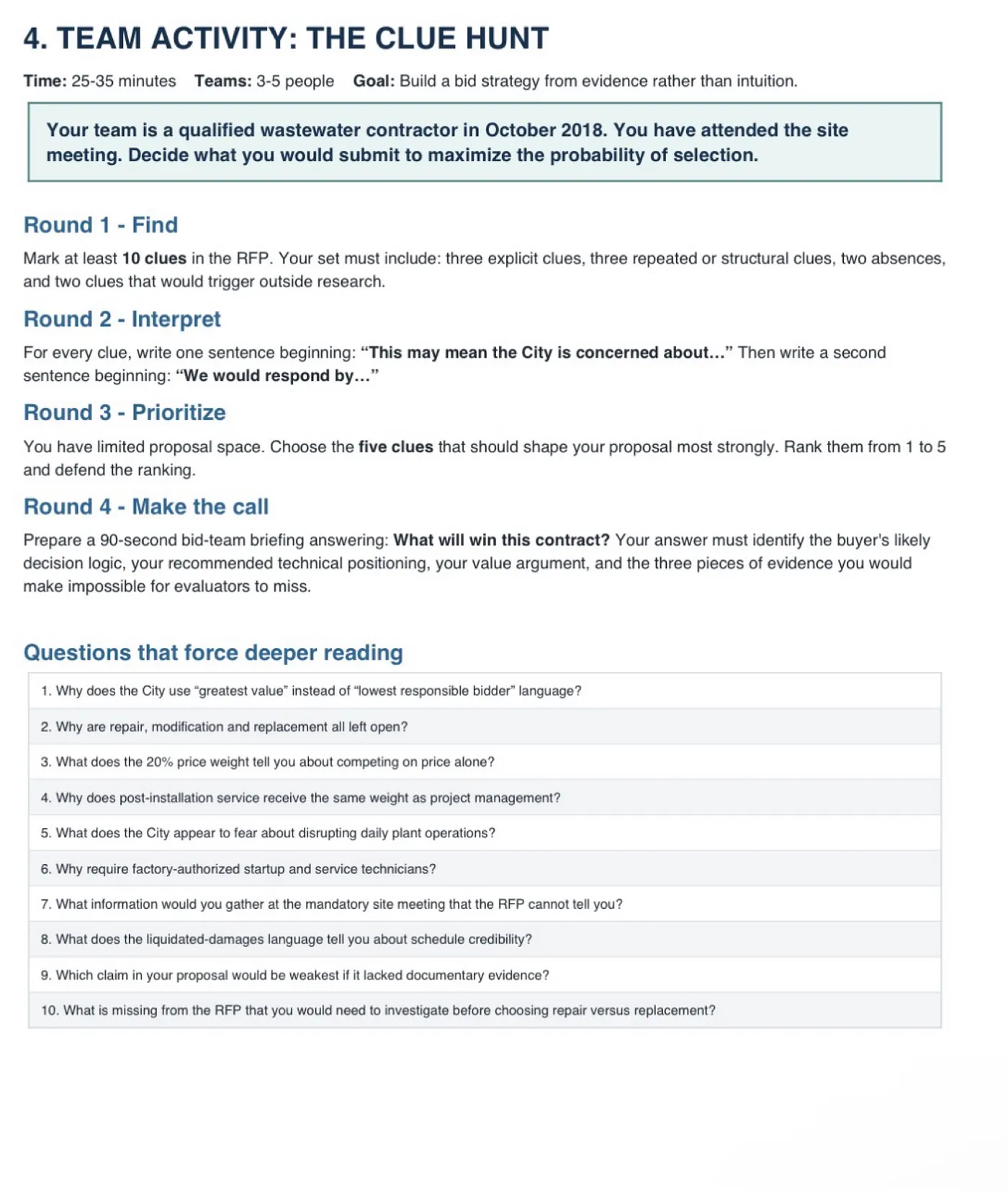
15 to 30 min Clue hunt. Teams look for repetition, unusual specificity, open requirements, missing information, and places requiring supplemental research.
30 to 40 min Evidence → Interpretation → Decision. Teams work their strongest clues through the worksheet.
40 to 50 min What will win? Each team selects five clues and develops its proposal strategy.
50 to 57 min Project Business connection. Debrief through Project Business Foundation and PBP concepts: customer, value, commercial relationships, risk, commitments, and the transition from opportunity to delivery.
57 to 60 min Individual self assessment and reflection.
Self assessment
1 = I need more practice
3 = I can do this with some guidance
5 = I can confidently apply this in project business
Self Rating Questions:
I can identify the difference between a mandatory RFP requirement and a clue about what the customer values.
I can use evaluation weights to understand how the customer is likely to make its decision.
I can recognize repeated language and unusual specificity that may signal an important customer concern.
I can recognize places where an RFP gives the bidder room to exercise professional judgment.
I can separate what the evidence actually says from my interpretation of what it might mean.
I can identify supplemental research that would help me understand the opportunity and customer.
I can translate an RFP clue into a decision about scope, technical approach, schedule, risk, price, or service.
I can explain how proposal commitments can shape the project that the delivery team eventually inherits.
I can use project business thinking to examine the customer’s definition of value rather than treating proposal development primarily as a compliance exercise.
Given an unfamiliar RFP, I could develop and defend a proposal strategy using evidence from the solicitation and supplemental research.
Reflection questions
What did you notice on your second reading that you missed on your first?
Which clue changed your thinking about what could win the work, and why?
What is one question you will ask the next time you read an RFP that you probably would not have asked before this workshop?
Full RFP:
https://rigov.org/DocumentCenter/View/13714/RFP—Repair-Modification-or-Replacement-of-Grit-Collector-System?bidId=
- T. Casey LaFrance