
Learning Objectives
By the end of the workshop, participants should be able to trace strategic benefits to operational evidence, construct a basic Benefit Breakdown Structure, identify benefit owners, interpret Earned Benefit information, connect project risks and changes to the benefits they affect, and use benefit evidence to support decisions among project partners.
The workshop is designed around application.
Participants can use the Riverbend case throughout the session, then repeat the exercises using a project from their own experience.
Why Benefit Engineering?
Scope, schedule, and cost tell us quite a bit about delivery. They tell us considerably less about what happens because of that delivery.
A new pump station can open on schedule while operators struggle to use its controls. A technology system can satisfy its specifications while creating additional work for the people using it.
A transportation project can add capacity while leaving the access problem that justified the investment largely unchanged.
These are project business questions because somebody committed resources based on an expectation of value.
Benefit Engineering brings that expectation into planning, execution, risk management, change control, governance, and eventually closeout.
We ask: Are the benefits that justified this investment actually arriving?
That question becomes especially useful in partnered projects because value rarely belongs to one organization alone.
The Riverbend Resilience Project
Riverbend has a problem.
Its wastewater pump station is roughly forty years old and approaching capacity. Heavy rainfall increasingly strains the system. Emergency maintenance has been climbing, and planned residential development will create additional demand.
A state infrastructure grant gives the community an opportunity to replace the station while improving flood resilience.
The proposed project includes new pumps and controls, backup power, flood protection, remote monitoring, and improvements to the site and maintenance access.
Several partners have to make it work.
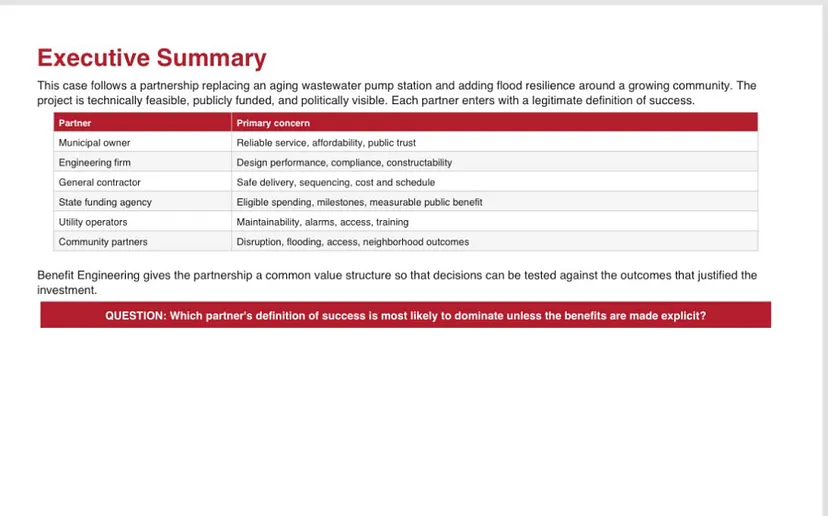
The municipality owns the infrastructure and carries responsibility for reliable service and affordability. The engineering firm is concerned with performance, compliance, and constructability.
The general contractor has to deliver the work safely while managing cost, sequencing, and schedule.
The state funding agency needs eligible expenditures and evidence of public benefit.
Utility operators will inherit whatever gets built.
Community partners care about flooding, construction disruption, access, and what the investment actually does for the neighborhood.
Each perspective makes sense.
The problem comes when those perspectives remain separate.
Benefit Engineering gives the partnership somewhere to connect them
- T. Casey LaFrance